OpenAI's $852B Valuation and IPO Plans: A Developer's Honest Take
OpenAI closed a $122B funding round, is burning $14B this year, and wants to go public by Q4 2026. Here's what that actually means if you build on their APIs.
The Numbers
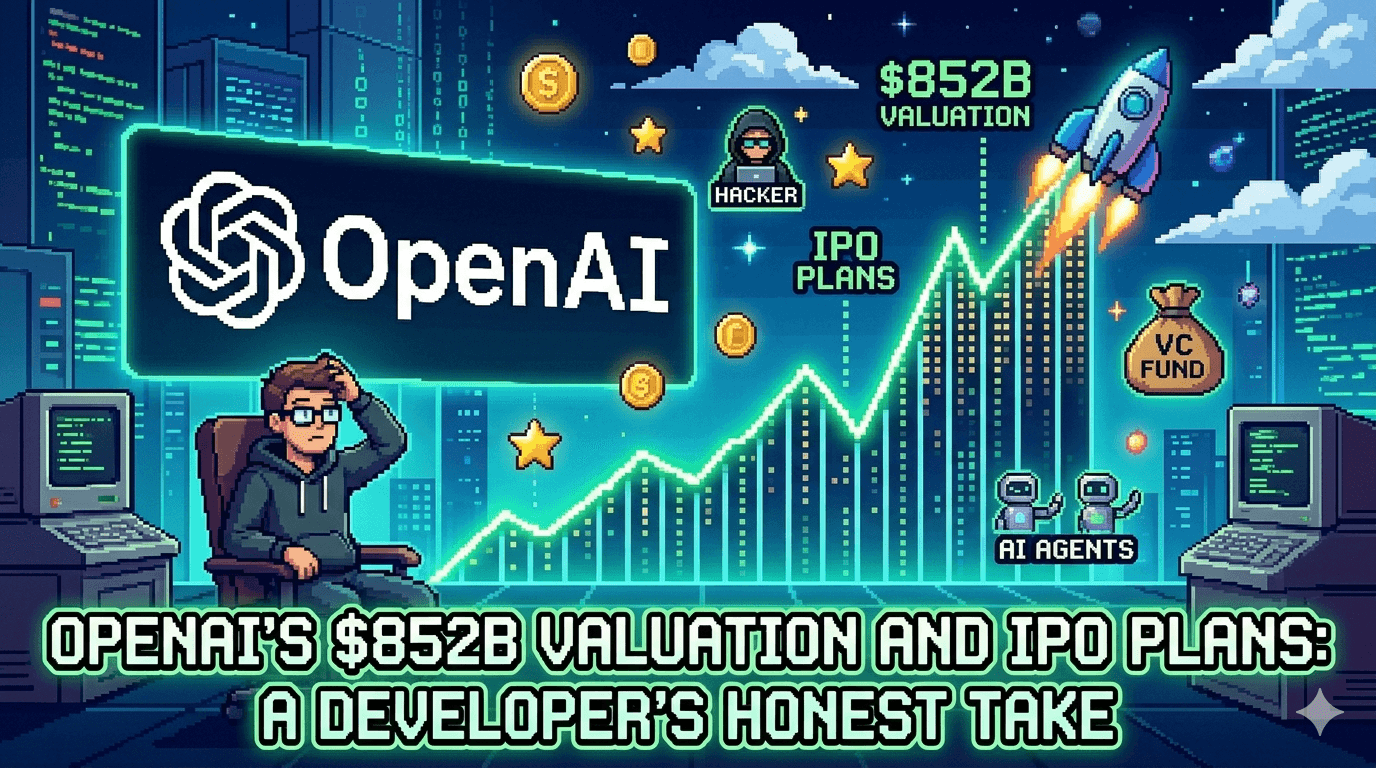
OpenAI closed its latest funding round on March 31, 2026. The final number: $122 billion in committed capital at an $852 billion post-money valuation. That makes it the largest private financing in history.
Amazon led with up to $50 billion. Nvidia and SoftBank each put in $30 billion. Microsoft participated too. And for the first time, OpenAI let retail investors in — they expected to raise about $1 billion from individuals through bank channels, but demand tripled that to $3 billion.
The company pulls in $2 billion a month in revenue. They had $13.1 billion in revenue for 2025 and are projecting $29.4 billion for 2026. Over 900 million weekly active users, 50 million paid subscribers, 9 million paying business users.
Those are absurd numbers. But there's a catch.
The $14 Billion Hole
OpenAI is projected to lose $14 billion in 2026. Their gross margin actually went *down* — from 40% in 2024 to 33% in 2025 — because inference costs quadrupled. Running these models at scale is extraordinarily expensive, and every new user makes the hole deeper before subscriptions cover the cost.
The company's own projections say profitability won't arrive until 2029, at which point they'd need $100 billion in annual revenue. That's a five-to-ten-x jump from where they are now, in three years.
So you've got a company making $2 billion a month that is simultaneously burning cash faster than almost any company in history. That's the tension driving everything else.
Why the IPO, and Why Now
CFO Sarah Friar confirmed on April 8 that OpenAI will "for sure" reserve a slice of IPO shares for retail investors. The company could file with the SEC in the second half of 2026, with an IPO potentially landing in Q4 — targeting a valuation of up to $1 trillion.
Friar drew a comparison to her time at Square, where they ran a direct selling program for small business owners during that IPO. Her pitch: "AI needs to garner trust in everything that we do. It has to be that everyone partakes, that it isn't just that a very small group, and everyone else gets left behind."
Meanwhile, ARK Invest already bought $240 million in OpenAI shares across three of their ETFs. If you own ARKK, ARKW, or ARKF, you already have a small OpenAI position.
But here's what's really going on: OpenAI needs the money. The $122 billion sounds enormous, but when you're losing $14 billion a year and building data centers at scale, that runway isn't as long as it looks. Going public opens a permanent capital tap.
The Corporate Structure Shift
OpenAI isn't the scrappy nonprofit lab from 2015 anymore. They restructured into a Public Benefit Corporation (PBC) called OpenAI Group, with the original nonprofit becoming the OpenAI Foundation. The Foundation holds 26% of the for-profit entity, Microsoft owns 27%, and the remaining 47% sits with other investors and employees.
A PBC is legally required to balance shareholder returns with a social mission. Anthropic and xAI are structured the same way. In practice, it means OpenAI can raise money, pay investors, and go public — while still pointing to a charter that says they care about humanity.
Whether that structure actually constrains behavior once public shareholders start demanding quarterly results is a different question entirely.
What This Means If You Build on Their APIs
This is the part I care about most. If you're a developer shipping products on OpenAI's APIs, here's what to think about:
Pricing is going to change. OpenAI's head of ChatGPT described their current pricing model as "accidental" and said it will "significantly evolve." Right now, GPT-5.4 costs $2.50 per million input tokens and $15 per million output tokens. That's competitive. But a public company losing $14 billion a year faces enormous pressure to improve margins. Your unit economics could shift under your feet.
Enterprise is eating everything. Enterprise already accounts for over 40% of revenue and is on track for parity with consumer by year-end. OpenAI shut down Sora — their video generation product was burning $1 million a day with fewer than 500,000 users — and redirected resources toward coding tools and enterprise features. The Disney deal fell apart. The message is clear: consumer novelties are out, revenue-generating enterprise products are in.
Codex is a big deal, but Claude Code is winning. Codex hit 1.6 million weekly active users, tripling after the GPT-5.3 launch. Enterprise clients like Cisco, Nvidia, and Rakuten have deployed it across dev teams. But Anthropic now commands 54% of the AI coding market — two and a half times OpenAI's 21%. Claude Code reached a $1 billion annualized run rate faster than ChatGPT did. And 46% of developers name it their "most loved" tool, more than double the next competitor.
The "superapp" vision creates platform risk. OpenAI is building toward an integrated platform — search, coding, agents, image generation — all in one place. That's great if you're a user. If you're a startup wrapping their API with a clever prompt and some UI, your moat just got thinner. The advice is old but worth repeating: own proprietary data, domain expertise, or distribution. Not just an API key.
My Take
The bull case for OpenAI is that they're doing what Amazon did in the 2000s — burning cash to build infrastructure that will eventually print money at scale. The bear case is that margins are going the wrong direction, competition is real, and public market investors are less patient than SoftBank.
For developers, the practical advice is boring but true: don't bet your product on a single provider. Build evaluation pipelines. Make your model layer swappable. The fact that 79% of Anthropic's paying customers also pay for OpenAI tells you that even enterprises are hedging.
OpenAI going public doesn't change the quality of GPT-5.4. It doesn't make your code worse or better. But it does mean the company will face quarterly earnings calls, analyst expectations, and shareholder pressure. That pressure will eventually flow through to API pricing, rate limits, terms of service, and feature prioritization.
Build accordingly.
More Articles
Atlassian Brings Lovable, Replit, and Gamma Agents Into Confluence